Freight Analytics Case Study: 7 Proven Wins with a Power BI Dashboard
Intro: The Hidden Cost of Flying Blind
Freight operations don’t usually fail in dramatic fashion. They quietly bleed—through misrouted loads, under-utilized trailers, inconsistent carrier performance, and slow manual reporting. Leaders sense the margin leakage but can’t pinpoint where it’s happening quickly enough to stop it. Meanwhile, rates yo-yo, labor is scarce, and the network never sits still. In this freight analytics case study, you’ll see how a mid-size carrier used Power BI to bring control and profitability back into freight operations. Industry data underscores the pressure: logistics is in a technology race, with leaders investing in visibility, telematics, and planning tools to reduce cost and improve productivity across transportation and warehousing. That momentum isn’t optional anymore—it’s survival. McKinsey & Company
This freight analytics case study shows how a mid-size U.S. freight company (300 trucks, mix of dedicated and spot) turned fragmented TMS/ERP reports into a Power BI logistics dashboard that executives actually use. The result: faster decisions, lower cost per shipment, stronger carrier accountability, and on-time performance moving from “acceptable” to “repeatable.”
The Challenge: When Freight Operations Outrun Visibility
In this freight analytics case study, the company’s reporting lived in silos. Transportation Management System (TMS) exports, ERP cost reports, and telematics data were all there—but scattered, stale, and inconsistent. Analysts manually stitched weekly PDFs; operations managers relied on tribal knowledge; finance and sales ran parallel spreadsheets to explain variances. The symptoms:
- Freight cost surprises late in the month
- Under-utilized assets (deadhead and idle time)
- Carrier performance tracked inconsistently across lanes
- Invoice disputes with little evidence to resolve quickly
None of this is unique—U.S. supply chains have navigated volatility and cost spikes for several years, and leaders are doubling down on technology to regain control. Penske Logistics The fix isn’t “more data.” It’s trusted, decision-ready data presented so a dispatcher, a regional ops leader, and a CFO can all act in minutes, not weeks.
This freight analytics case study shows why Freight Analytics Is a Strategic Imperative (Not a “Nice to Have”)
Freight analytics is the discipline of collecting, analyzing, and interpreting shipment, cost, performance, and inventory data to improve decisions and outcomes. Done right, analytics links executive goals (margin, service, growth) to operational levers (carrier mix, routing, asset use, contracts) and quantifies impact. Sedna
Executives care because the payoff is real: when logistics leaders use data to inform pricing, routing, and performance conversations, they can gain revenue and operating profit advantages—sometimes from smarter pricing, sometimes from cost reduction, often from both. McKinsey & Company And because the logistics landscape keeps shifting (costs, demand, constraints), a live dashboard becomes an operating system—not a quarterly report. McKinsey & Company
Defining KPIs That Actually Change Behavior
Below are KPIs we used in our freight analytics case study for executive alignment. Dashboards aren’t decoration. They’re decision tools. We aligned on a short list of freight KPIs tied to executive questions and assigned clear ownership:
| KPI | What It Means | Who Owns It | Why It Matters |
| Cost per Shipment | Total transportation cost ÷ shipments | Finance + Ops | Core profitability metric; trend by lane, carrier, customer |
| On-Time Delivery (OTD) | % of shipments delivered on or before appointment | Regional Ops | Customer experience + penalty avoidance |
| Asset Utilization | Loaded miles / total miles; trailer dwell | Fleet/Dispatch | Reduces deadhead, improves turns |
| Freight Cost Variance | Actual vs. planned by lane/carrier | Finance | Reveals overruns and negotiation targets |
| Claim Rate | % of shipments with claims | Quality/Ops | Quality + carrier accountability |
| Accessorials per Shipment | Average accessorial cost | Finance + Ops | Controls hidden cost drivers |
Design principle: If a KPI doesn’t drive a weekly action (re-route, re-negotiate, re-sequence, or fix a process), it doesn’t belong on Page 1.
Data Integration: From TMS/ERP/Telematics to a Unified Model
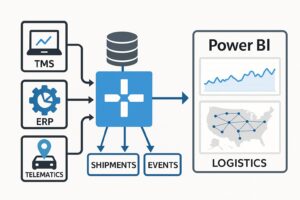
We built a star-schema model in Power BI: a Shipments fact table (dates, cost, status) with dimensions for Carrier, Customer, Lane/Region, Mode, and Equipment. Data sources included:
- TMS exports for shipment lifecycle, lanes, and carrier assignments
- ERP cost/GL detail for line-item accuracy (linehaul, fuel, accessorials)
- Telematics for location pings, loaded/empty, and dwell time
- Carrier scorecards (on-time, claim rates)
- Customer SLAs and appointment windows
For context and benchmarking, the U.S. DOT’s Bureau of Transportation Statistics provides public freight data programs (e.g., FAF) that can help trend lanes and modes regionally. Bureau of Transportation Statistics
Integration challenges we solved: mismatched calendars (ISO weeks vs fiscal), late file drops, duplicate loads from re-tenders, and inconsistent carrier naming. We used simple automation to normalize files and a single semantic model to keep definitions consistent. This unified model became the backbone of our freight analytics case study dashboard.
The Dashboard: Four Tabs That Run the Business
We kept it simple and role-based. Executives get clarity; managers get levers; analysts get receipts.
1) Executive Overview (answer the big questions)
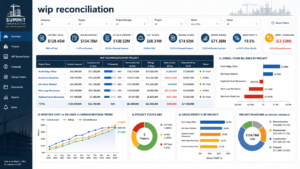
- KPI cards: Cost per Shipment, OTD, Asset Utilization, Freight Cost Variance
- Trend tiles: 13-week moving averages with target bands
- Heatmap: Accessorial cost by lane (exposes “leaky” lanes fast)
- Carrier Mix: Volume and spend concentration (shows dependency risk)
Story in the numbers: The West region’s cost per shipment jumped 8% in four weeks. The dashboard traced the pattern to two lanes with rising accessorials and higher spot exposure.
2) Operations Control (what to fix this week)
- Lane Drilldown: Volume, cost, OTD by lane and customer
- Carrier Performance: OTD distribution, claim rate, dwell time
- Asset Utilization: Loaded vs. empty miles by region; trailer dwell aging
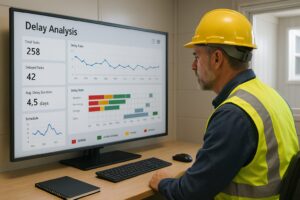
- Exception Feed: Late shipments, dwell > target, repeat accessorial offenders
Action: Dispatch rebalanced loads to higher-performing carriers in those lanes, set dwell alerts at two DCs, and added a target for “accessorials per shipment” in weekly ops huddles.
3) Financials & Variance (where the money goes)
- Planned vs. Actual Cost: by lane, carrier, and customer
- Accessorials by Type: lumper, layover, detention, reconsignment
- Fuel Surcharge Tracking vs. benchmark index
- Price Realization: Contract vs. spot
Decision: Finance used the freight cost optimization analytics to justify carrier negotiations and re-rate a subset of lanes, guided by a variance waterfall that executives could understand in seconds.
4) Deep Dive (receipts, not guesses)
- Shipment-level table: pickup, delivery, appointment, carrier, rate, accessorials, dwell, POD
- Click-through evidence: BOL/POD, timestamp logs, exception notes, images
- Root Cause Codes: standardized to avoid “catch-all” buckets
This tab ended “he-said, she-said” debates. When a claim or a charge hit, the team could prove what happened.

Impact: What Changed in 90 Days
The outcomes of our freight analytics case study were measurable within one quarter:
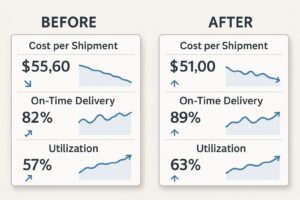
- Cost per shipment: ↓ 14.7% in targeted lanes (mix shift + accessorial control)
- On-time delivery: +6–8 points (region dependent), driven by carrier accountability
- Asset utilization: Loaded mile ratio improved, deadhead ↓ 10% in two regions
- Manual reporting: 80% less analyst time assembling weekly PDFs
- Carrier negotiations: Data-backed scorecards improved terms and performance reviews
These numbers align with broader industry evidence: technology-led visibility and smarter commercial levers (including pricing) can translate to measurable revenue and profit improvements. McKinsey & Company+1 And the macro context from CSCMP/Kearney reinforces why operations are tightening up analytics now—after years of volatility, leaders are using data to plan and invest more confidently. Penske Logistics
Lessons Learned (So You Don’t Learn the Hard Way)
This freight analytics case study revealed five leadership habits that drive BI adoption.
1) Start with decisions, not data.
We asked executives: “What decision do you make weekly that would be 5× better with clean, timely data?” Those answers became Page 1.
2) Name owners per KPI.
“Cost per Shipment” means nothing unless someone owns the levers (mix, routing, carrier terms) and a weekly target.
3) Don’t boil the ocean.
Pick 2–3 problem lanes or customers. A freight data dashboard that fixes one headache will earn you the right to scale.
4) Stabilize the vocabulary.
Agree on what “on-time” means across customers and carriers; normalize lane names and carrier IDs; kill the “miscellaneous” bucket.
5) Make it a management ritual.
A 30-minute weekly review using the same page. Decide → assign → date. Dashboards don’t change behavior; rituals do.
Architecture Notes (Lightweight, Durable)
We landed source files via SharePoint/Blob storage, standardized with light Power Automate flows, and modeled in Power BI with incremental refresh for the last 90 days.
Facts: Shipments, Costs, Events;
Dimensions: Date, Carrier, Customer, Lane, Equipment, Region.
We used row-level security for regional teams and an app for execs. The same blueprint works whether you’re a shipper or a carrier—just adjust ownership and measures. We reused this architecture across other freight analytics case study pilots for similar results.
What to Watch (External Benchmarks & Trends)
- Digital logistics adoption: Real-time visibility, planning, and telematics remain high-investment areas—align your roadmap accordingly. McKinsey & Company
- Pricing discipline: Even a 2–4% pricing improvement can lift operating profit 30–60% if you get your pricing analytics right. McKinsey & Company
- Macro dynamics & spend: CSCMP/Kearney’s State of Logistics summarizes U.S. logistics costs and investment focus—use it to calibrate your targets. Penske Logistics
- Public freight datasets: BTS/FAF can contextualize your lanes and modes as you grow analytics maturity. Bureau of Transportation Statistics
Case Study Summary (At a Glance) – Freight Analytics Case Study Recap
Company: Mid-size freight carrier/3PL (300 trucks, multi-region)
Problem: Fragmented reporting; rising cost per shipment; inconsistent OTD
Solution: Power BI logistics dashboard with four tabs (Exec, Ops, Finance, Deep Dive)
Data: TMS + ERP + telematics; carrier scorecards; SLA master
Outcome (90 days): Cost/OTD/utilization improvements; 80% less manual reporting; stronger carrier negotiations
Why it worked: Business-first KPIs, owners per metric, weekly ritual, receipts for every exception
See It in Action
Want a fast, low-risk way to prove ROI? We’ll build a pilot freight analytics dashboard focused on your top two lanes and one customer in 4–6 weeks—using your existing tools.
Ready to start your own freight analytics? Explore our Power BI Consulting Services.
FAQ
The following FAQs came directly from client teams during our freight analytics case study rollout.
Which KPIs matter most for freight analytics?
Start with Cost per Shipment, On-Time Delivery, Asset Utilization, Freight Cost Variance, and Accessorials per Shipment. Expand to Claim Rate, Price Realization, and Carrier Mix as maturity grows. These KPIs proved most valuable during our freight analytics case study rollout
How fast can we launch a pilot?
Most mid-size freight companies can pilot in 6–10 weeks, depending on data access and cleansing. Start with a narrow scope (two lanes, one customer) to prove value quickly.
Do we need a new TMS/ERP?
No. You can start with exports from your current TMS/ERP and telematics. Mature later into API/ETL pipelines once ROI is proven.
What ROI is realistic?
Savings vary, but it’s common to see 10–15% reductions in cost per shipment on targeted lanes, OTD improvements of 5–10 points, and a large cut in manual reporting time. Results depend on your baseline and discipline.
Will this work for carriers and shippers alike?
Yes—KPIs and levers differ slightly (e.g., routing vs. contract adherence), but the same freight operations business intelligence principles apply.